streubel

Christ-follower, Dad, Runner, and Scientist
AIM: revstrube
Haiti Trip #1
Posted in Uncategorized on August 29, 2011
Three weeks ago I travelled into Haiti for my initial orientation of how Convoy of Hope operates on the ground and the role I will play in it. During the six days of travel I was immersed in the culture and truly saw a large portion of the country, especially the areas I will be focusing my efforts. On arrival I was pleased I could put my experiences from Nigeria, Thailand, Sri Lanka, and Grenada together to combine what Haiti was like in smells, geography, and culture. If I had not had those previous experiences this would have been a dramatic culture shock to my system. However, with that being said, Haiti is a poor country and I saw the things one would expect.
 The first couple days of travel included connecting with local rice farmers who are currently growing rice for our children’s feeding program (CFI). Convoy is one of two organizations working in Haiti that are deliberately purchasing Haiti grown rice in their program. (Convoy pays more in this approach but the goals is helping the local growers) My role is to be a resource for the growers as they try to increase their capacity. The story of Haitian rice production is a long sad one, but in short US rice coming into the country over the last 20 years has killed the local market and destroyed farmer incentive. This is a picture of me with the president of the new local rice federation during a Q and A session.
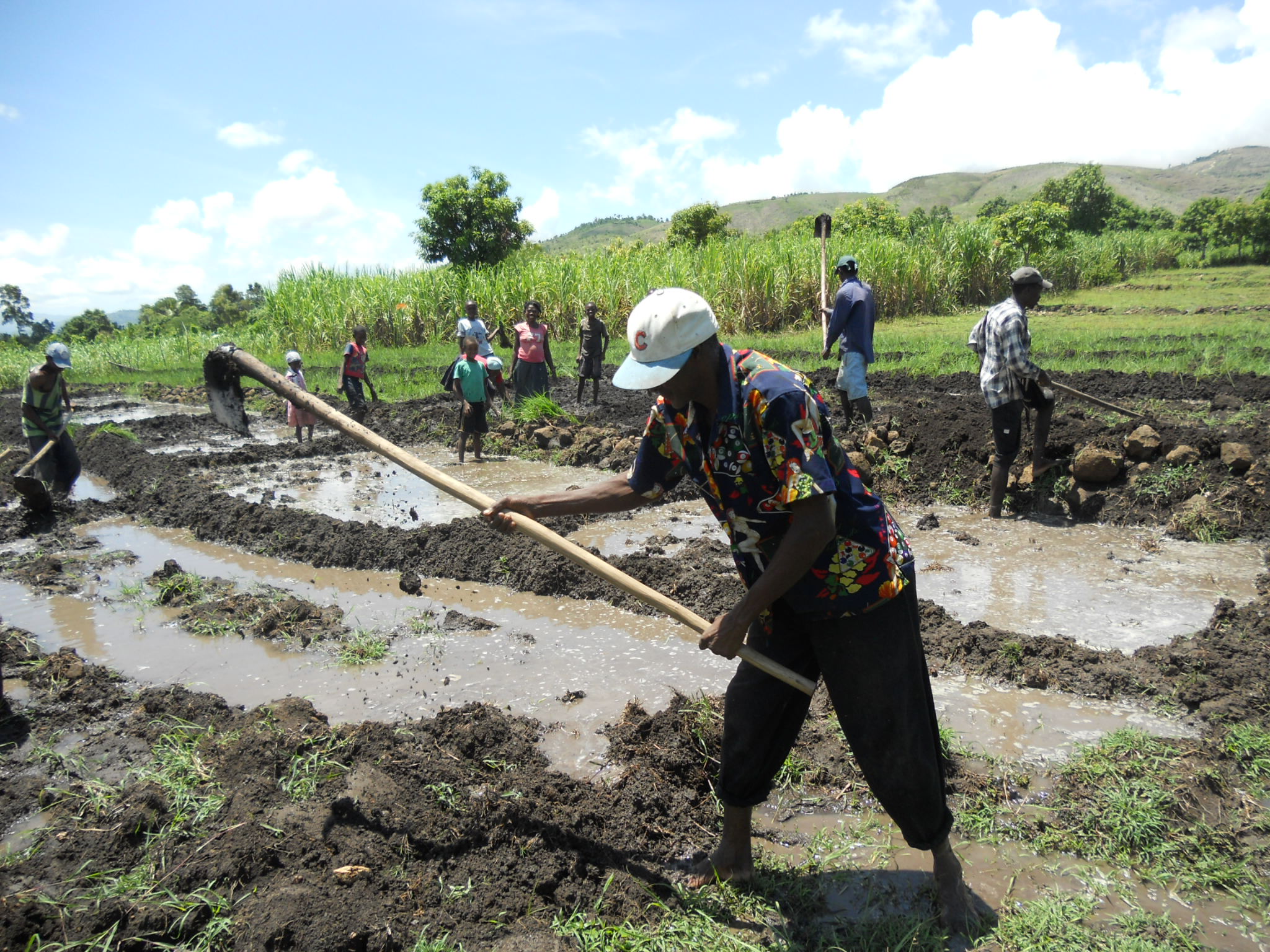 We also spent a couple days in the mountain regions where I will be connected with local farmers in an effort to help them with their food production. One of the main worries is water management during the dry season and best management practices for the more 24 crops grown in the region. When wandering through the farm areas it is evident the knowledge is there but not everyone received the information. In the mountains I will be working with 208 identified farmers connected to local feeding programs and information transfer will be one of our main focuses. As most people should know, whether in Haiti, Africa, or North Dakota you should never count a farmer as dumb. Below are some rice farmers we came across after walking up a trail for 30 minutes.
 I also got to see first hand the benefit Convoy is having on the ground in Haiti. I can say without bias (for real) the investments people are making into Convoy are going to kids. One of the things that impressed me about COH was the accountability and screening involved for those partnering with Convoy. There are very strong measures being taken to assure lack of corporation and during the school year monthly health reports are required from every child being helped. Here is one of those pictures I just had to snap.
 Lastly, we got to see the damage remaining from the earthquake. People ask what was it like? The damage is still widespread and the recovery is slow, however what did surprise me was the overall randomness of the damage. There were areas harder hit but still in those hardest hit areas some buildings remained untouched. The tent cities remain and still grow in some cases, which adds to the impact of storms like Irene, but some progress is being made. The lack of progress is a combination of rules, culture, and politics (my opinion). He is the palace that the locals told me was the devil’s house.
It was a fascinating trip and the next report will be on specifics related to my role in the Haitian picture.
Liebig’s Law of the Minimum
Posted in Uncategorized on August 26, 2011
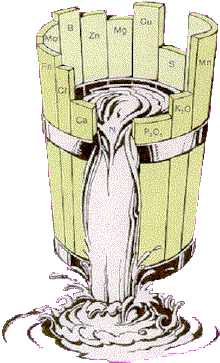 Over the course of time evaluation is necessary, although not always pleasant, always beneficial. Honest evaluation, the process of taking off the gloves and pounding loose the frayed edged and getting to the core. As the raw core is exposed one discovers true strengths and weaknesses. The strengths are then praised and refined while the weaknesses are treated, rebuilt, or eliminated. It is when we address the weak, without reservation, we move forward in long-term strength and growth.
Liebig’s Law of the Minimum states, “Growth is controlled not by the total amount of resources available but by the scarcest resource (Limiting Factor)”. It is our weaknesses (limiting factors), which determine the true yield potential. The limiting factors, even when not considered a weakness, must be addressed. In an organization there’s vision, value, staffing, infrastructure or forethought, in the personal dimension skills, education, resources, and most likely character all can be considered. However, by confronting the limiting factors we prepare for the overwhelming blessing God has for us on the horizon for from the Refiner’s fire comes what He desires.
The question then becomes, when was the last time you opened up yourself for God to address the limiting factors in your life and what did you do about it?
I have come to realize the PhD process was one large refining process to bring out the imperfections of my character. It is now time to address the limiting factors for when the next blessing comes God can be honored in my marriage, family, and life. It is never easy to see your character flaws in the mirror but thankfully His yoke is easy and his burden is light.
The Broken Bone Weekend
Posted in Uncategorized on August 22, 2011
It has been brought to my attention some people would like a few updates on the move to Springfield, MO and as I am working on some final edits for a paper thought this was a good lunchtime distraction.

We moved during the hottest summer on record keeping our kids inside the house, until last weekend. It was a beautiful Sunday afternoon, the wind was blowing and it was a nice 85 degrees with low humidity. As the good Dad I forced my kids (yes forced – it was a very long ordeal) to ride their bikes for at least 20 minutes before playing the Wii. Once the debate was over they jumped on the bikes and as a Dad trying to reinvent himself after graduate school I jumped on my bike to ride with them.
Now if you know my oldest he is a good combination of both his mother and me and this ride was bringing out the best of both – the competitive spirit with a side of talking trash. As any good Dad (remember trying to learn to let loose and have fun again) I challenged him to a race and consequently smoked him. This got the juices flowing and he was not going to be outdone. He turned the bike around and started back the other way (downhill) as fast has he could go – tempting me to catch him. As I blazed by him at 20 mph (32.1 km/h for my science friends) I heard the fateful crash. As I looked back on the hill here was my son sliding along the pavement with all the flare and volume he could make go along with it….
As I ran to his aid hoping it was pure drama verses reality I saw the blood and road rash. Hoping this was the climax for the crash I picked him up and watched his left arm drop at 90 degrees 2 inches (5cm) above the wrist. Yep – Dad was taking him to the ER. We walked home with his arm in a shirt made sling and the rest would be set in history by these words uttered to the ER.
“my Dad forced me to ride my bike when I just wanted to play the Wii – it is his fault”
The transition has been what you would expect when you move across the country to a new job away from family and friends. The journey of finding a home church and “our own posse” has not been the easiest. There is a good chance Mary’s posse is going to be Roller Derby! (tell her she should at least try) It has been great to connect with Northwest Network friends Bill and Marie Hennessy who have gone out of their way to show us how to manage Springfield. It is fun to see how friendships from a trip to Nigeria in 1999 can still remain strong. In the transition Noah (19 year old exchange student from Grandview came with us) has been a delight and made this whole process doable – especially helping Mary put the house together.
Streubel Update – One Chapter Closes and a New One Begins
Posted in Life on June 1, 2011
On May 7, 2011 an 11 year journey ended as I was presented my doctoral hood at Washington State’s commencement ceremony. The chapter of formal education in my life has final come to a close after 4 degrees. This conclusion, I have been told, has resulted in the only ordained Assemblies of God minister with a PhD in Soil Science. (If there are others please show yourself we need to talk). As the person who said they would never continue their formal education beyond a church ministries degree this truly was a divine helped and inspired journey.
One question I consistently receive is “why”? The simple answer – I believed I was placed on this earth for a purpose and that purpose is to bring hope to people, both spiritually and physically. For a more detailed response read https://streubel.wordpress.com/2008/08/27/hello-world/
As you may have assumed or my friends already know – I don’t always fit the normal standard curve. My journey has been a strange one, where at times there no place for me to fit, no model to follow. I was continually caught in a state of limbo. There is no divisional lunch at Network Council for soil scientist pastors with a heart to feed the world. My small group has been rather lonely (and Mary’s even smaller) HOWEVER my creator had a plan….His purpose was just around the corner.
In true irony two years ago when I was at my lowest – my God was orchestrating the beginnings of my new chapter by preparing a unique puzzle piece at a faith based disaster relief organization (Convoy of Hope) suited for someone who didn’t always fit the mold. http://www.convoyofhope.org
The week after graduation I was presented with two job offers – one academic (WSU tenure track faculty) and Convoy of Hope. As I sat around the table with leaders in the children’s feeding initiative everything started to come together for the first time. All the unique experiences from tilapia, chicken, goats, senior pasturing and even anaerobic digesters started to make sense and fall into place – as if my designer was saying “see I told you I could be trusted – you’re not crazy”.
So in the next three weeks Mary and I will be pulling up our roots in Washington and leaving for Springfield, Missouri to work with Convoy of Hope’s children’s feed initiative to development models for sustainability. We will be working with area farmers and children educating them on best management practices that work locally so Convoy can ultimately by their food from local suppliers plus by building the local capacity Convoy can focus on other geographical areas of need.
It will not be easy, there will be frustrations, it will take time, there are still lots of unknowns but most importantly…
I WAS MADE FOR THIS…and now the new chapter begins.
I CAN’T RUN NAKED..(The Nerdy Tech Stuff in my Running Bag)
Posted in Running Free - Brooks ID on February 4, 2011
Taking a break from phosphorus dynamics between manure and biochar (Phd dissertation) to follow up on what is inside my running bag.
As a borderline scientist I tend to be a little nerdy and want to account for all the variables if necessary. Yet there are days when I just strap on the shoes and run.
Identification: Having been almost run over a few times I am a fan of RoadID. I try to wear it on my wrist whenever I am out on the road. The family calls it the “death bracelet” I call it peace of mind.
Tracking Distance and Time: I have three options in my bag depending on where I am running. During long runs and all races I grab the GPS unit.
1) Garmin Forerunner 205 – it gives me time, distance, location, elevation etc. This unit is an older model but serves its purpose very well. I have very little trouble losing signal and one charge last forever.

2) Timex Heart Rate Monitor – to look at my fitness I will strap on the chest piece and track my HR throughout my run. This gives me a good look at how hard I am working.
3) Soleus 10k Watch – I wear this 24/7 and it gives me my times with a good basic memory package for laps etc.
Weather: I like to know what is going on weather wise when I run. My current record is runs at 3oF and 104oF.
1) One thing about Washington is it has an extensive network of weather stations which save me a lot of time and effort. www.weather.wsu.edu (AgWeatherNet) gives me everything I want and more. I happen to have two stations accessible when running at work. Most states have some sort of free access agricultural weather monitoring system. WSU’s site is free to everyone thanks to farmers who provide funding.
2) I also carry a Brunton ADC-Summit hand held weather station with me when I don’t have accurate weather information available. This gives me wind, barometer, elevation, temps and wind chill. (NERD)
Recording Mileage: I have tried several logging options over the years. I have used Nike’s Plus system (yes with my Brooks shoes) but when the battery goes dead in the sensor it doesn’t work. Currently I use Sweat360.com and the Brooks Running Club site on Facebook but honestly I do a better job of keeping a hard copy with pencil and paper. Dailymile is a good site too if you are looking for easy.
Music: Deep down I tend to be a purest and have never ran a race with any sort of MP3 device. I run with music about 15% of the time, and when I do I use an iPod I used to run with a Sony Walkman (Tape edition)
Of course you don’t need all the technology to enjoy the run but for me having information is good!
My Running Gear
Posted in Uncategorized on February 2, 2011
In response to some questions about my running gear thought I would let people into my running bag. There are several places people can go for gear advice but hopefully you find it useful to see what I wear and Run Happy.
Disclaimer: In full disclosure I am a member of the Brooks Running Pace Team (since 2010) which is about giving regular guys like me the opportunity to feel like a rock star. HOWEVER I have been running in Brooks gear since the mid-1990’s so the closet was full of Brooks before the ID Program. http://www.runbrooks.com/brooksid
The Top:
Outer Shell Top: A long sleeve Brooks NightLife jacket (Marathon Maniac Issue Member #1475. This is bright and reflective so I can run at anytime of the day and know people will see me. This color also keeps the Grandview gangs from flashing signs at me. (Happens all the time when wearing blue or red Brooks jackets) Under the jacket I will wear a technical running shirt long or short depending on the temperature.
Bottoms: Brooks Elite Shorts or Spartan Pant 2 running pant. I do have several pairs of shorts both longer and short, my ultimate choice revolves around how much flesh I want to show for the day 🙂 I do believe real runners wear short-shorts. (my friends don’t agree)
Shoes: Brooks Adrenaline GTS Series. Brooks currently is on the 11 model I am still wearing the 10. (http://www.brooksrunning.com/Brooks-Adrenaline-GTS-11-Mens-Running-Shoe) When I run in this series I have been averaging 500 miles per set of shoes. I stop at 500 so I can wear the shoes around the lab etc. I would be able to get more out of them if I needed. My current pair is almost at 400 miles.
Socks: Although some do not see why I would want to spend $20 on running socks. I promise it makes all the difference in a marathon (or 5k). I use several of the Brooks socks and get 2 years of running out of a pair before they are done. After biting the bullet on my first pair of running socks I have never gotten a blister or hot spot. I will never go back.
Next post – My nerdy tech stuff
Are You Done Yet?
Numerous of our family and friends have ask about my progress and when they get to call me Dr. or when I can afford to take my wife out to dinner. So here is the latest update:
The last six months have been full of set backs, rescheduled dates, and experimental reruns which ultimately shattered any hope of a December 2010 graduation. I am currently in the writing process submitting drafts to my committee chair and then rewriting, rewriting, rewriting….you get the picture. In a research based PhD publications are the key and required by the department at WSU (at least 1). They are how your committee and chair get a return on their investment of time and money. In most cases a graduate student finishes their dissertation and then publishes the outcome after graduation or a combination. My committee chair however wants everything that can be published already submitted prior to my defense. The difference between dissertation and publication ready are VAST, as I have found out in the last 4 months.
My PhD dissertation encompasses 4 major chapters (it was 3 until Friday afternoon).
1) Literature Review
2) “Influence of Biochar on Soil pH, Water Holding Capacity, Nitrogen and Carbon Dynamics. ”
3) Characterization of Biochar made from dairy manure fiber and its ability to sequester phosphorus from dairy lagoons
4) The impact of phosphorus recovered from dairy manure using biochar on soil characteristics and crop yield.
Progress: Chapter 1 – 80% complete but will be in revision until defense
Chapter 2 – DONE Accepted to SSSJA
Chapter 3 and 4 – Writing and rewriting
So it boils down to this – we are not setting any dates for my defense BUT it must happen before April 1, 2011 and I will walk in May.
Thanks for the prayers!
When Goats Pee
Posted in Running Free - Brooks ID on March 12, 2010
Over the last two months a new running group has been established at WSU’s Irrigated Agriculture Research and Extension Center in Prosser, WA. On any given day there is the potential of 4 or more runners heading out for a nice lunch run around the roads of the beautiful Yakima Valley.
Yesterday was not one of those days as everyone’s schedules have been a little different making running alone necessary. The thing about our running routes is the amount of dogs who like to come and greet us alone the way. Depending on the day we each take turns yelling at or rushing the dogs giving them the scare of their lives…or at least reminding them they make us nervous.
Yesterday however, there was no one to help deflect the dog attacks, it was just me. The beginning of the run was relatively calm with less then normal dog action but all of a sudden one of the usual suspects started running from the front porch to make my leg into his lunch snack. On the normal day the 4 foot fence keeps him at bay but today (of course when I was alone) he jumped the fence without hesitation coming to hunt me down. In that moment of panic I saw my new Brooks GTS 10’s being ripped in two and my new Brooks ID Elite shorts pulled to my ankles tripping me into ball of shame in the middle of the road. Somewhere out of my inner most soul it came, the loudest, most gnarly exclamation I have ever made “Go Lay Down”. The dog’s hair rose throughout its back and stopped dead in his tracks retreating to behind the protection of this fence.
In was in that moment of pride and relief I noticed that in the adjacent field the 15 plus goats were eyeing me down and in peeing in unison. (As a former goat owner I have seen this response before) The urination in fear response is a classic.
With my Brooks gear unharmed and firmly around my waist I finished my run and returned to the world of graduate school with the ever present reminder that my voice and face are capable of making goats pee. May my anger never reach that point with my kids because that is not how a Dad should ever be remembered.
A Little Self Promotion – Front Page Tri Cities Herald
Scientists see biochar as promising fuel source
By Kevin McCullen, Herald staff writer

Scientists in Eastern Washington are at the forefront of research into an ancient practice that shows promise as a clean fuel source, a way to improve soil condition and to capture carbon that otherwise would be released into the atmosphere.
Researchers from Pacific Northwest National Laboratory, the federal Department of Agriculture’s research station in Prosser and Washington State University have been integral figures in studies of biochar and its potential uses.
Biochar, a charcoal-like material, is produced when biomass — including wood, plant and animal waste — is burned in the absence of or under low oxygen conditions so the material doesn’t combust.
This process, called pyrolysis, thermally decomposes the waste into biochar, bio-oil and syngas. Biochar and bio-oil show commercial promise and syngas offers a power source that can run a pyrolyzer.
The USDA’s Agricultural Research Service has estimated that if the United States were to pyrolyze 1.3 billion tons of various forms of biomass annually, it could replace 1.9 billion barrels of imported oil with bio-oil. That would represent about 25 percent of the annual oil consumption in this country. In addition, USDA estimates the country could sequester 153 million tons of carbon annually by adding biochar to soils.
Although widespread research on biochar began less than a decade ago, debate already is brewing on whether its prevailing commercial use will be for fuel or for soil and carbon sequestration.
In January, UOP, a subsidiary of the Honeywell Corp., announced it had been awarded a $25 million grant from the federal Department of Energy to build a demonstration plant in Hawaii to take waste feedstocks of wood, agricultural products and algae residue to produce bio-oil. The oil then will be refined into aviation and diesel fuel with technology developed in part by PNNL, a junior partner in the project.
Biofuels, including bio-oil from char, “can’t replace all petroleum,” said Doug Elliott, staff scientist with PNNL’s Chemical and Biological Process Development unit. He has been researching biofuels for three decades.
“But U.S. production of biofuels could replace one-third of our total petroleum products annually and on a continuing basis,” he said.
Could create jobs
Or the use of smaller portable pyrolyzer units one day could be deployed in forests to clean up wood waste piles, produce lower-grade fuel, generate power and create jobs in rural communities. The Forest Service is funding research of a small demonstration project in a small Northeastern Oregon community.
“There’s all kinds of things that are potentially usable as a fuel source. You can make this work on a whole lot of things that don’t have a value and actively have a cost,” said Eric Twombly of BioChar Products, who is conducting the forest fuels project in Halfway, Ore.
Twombly fired up his mobile plant in December at an old lumber mill site about eight miles from the Idaho border. He hopes to produce at least 500 tons of biochar and at least 300 gallons of bio-oil using chipped wood waste.
A farmer already is buying some of the oil to use in his orchard heaters, and Twombly uses the syngas to power the plant. It now employs three people, but Twombly envisions one day creating at least a dozen full-time, family-wage jobs.
And ongoing research by soil scientist Hal Collins and his team at the USDA’s vegetable and forage crop research unit in Prosser is looking at how dairy waste could be transformed on-site into a product that could be added to the soil, used as an energy source and to eliminate the environmental concerns of waste ponds.
Jim Amonette, a soil chemist at PNNL who has extensively studied biochar, and others say it isn’t a panacea that will resolve the nation’s energy and environmental challenges. But he says its potential use in storing carbon and as a soil amendment is promising.
“You are basically taking a biomass that would be back in the atmosphere in five to 10 years and converting it into biochar that will be in the soil for hundreds to thousands of years,” said Amonette, who contributed a chapter to Biochar for Environmental Management, considered one of the definitive reference works on the topic.
“It is one of the few ways you can pull carbon out of the air and generate energy at the same time,” he said.
Different products
The process isn’t new. Researchers have found areas in the Amazon basin where people centuries ago deposited charcoal, leaving behind areas with rich soils and lush plant growth. Scientists aren’t certain how they created the charcoal, said David Granatstein, a sustainable agriculture specialist at Washington State University and a co-principal investigator of a study published last year.
Scientists subsequently have found that different methods of pyrolysis — fast and slow, which are distinguished primarily by the rate of temperature increase in the pyrolyzing unit — produced different amounts of finished product.
Fast pyrolysis takes place in seconds, with temperatures that can reach up to 1,000 degrees. WSU researchers and Collins found in their study, released in 2009, that higher heating produced more bio-oil and less biochar from the same amount of biomass, while slow pyrolysis with slow heating rates yielded more char and less oil.
Amonette said research of the two methods in general has shown that a ton of biomass subjected to slow pyrolysis can produce up to 750 pounds of biochar, while the fast process yields 300 pounds of char.
Pressure to produce bio-oil could grow as oil prices continue climbing. UOP has said it expects to start fuel production in Hawaii no later than 2014. The company estimates it could produce gasoline and diesel for about $2.50 a gallon, Elliott said.
Others, however, tout the potential value of biochar for use in soils and in controlling greenhouse gases. Production of biochar locks up carbon from the biomass that would otherwise rot or be burned, and therefore decreases the amount of carbon dioxide returned to the atmosphere, according to researchers.
“By finding ways to keep this carbon out of the atmosphere for longer periods, we’re making better use of the service provided by plants when they remove carbon dioxide from the atmosphere during photosynthesis,” Amonette said.
Soil scientists also have found biochar is good for storing carbon because it takes a long time to decompose, Collins said. It also has shown promise in retaining phosphorous, nitrogen and potassium — helping prevent them from leaching into lakes and streams — and retains moisture because it is porous.
But research by soil scientists thus far suggests biochar isn’t a magic elixir for all types of soil. It may work best in tropical and highly weathered soils — such as in the southern U.S. — where minerals have leached out of soil.
“It’s not a nutrient. It imparts some characteristics that improve soil conditions,” Collins said.
His team in Prosser now is looking at transforming dairy wastes into a fuel source and reducing environmental issues with the waste. The researchers are taking manure run through a digester at an Outlook dairy, running it through a pelletizer to change it to pellet form, and then subjecting it to slow pyrolysis to produce bio-gas or bio-oil.
Biochar produced in the process is being applied to dairy waste water to remove excess nitrogen and phosphorus, which could be sold as a fertilizer.
“We think it shows a lot of promise,” Collins said.
Research will yield more clues into potential applications of biochar and bio-oil. Economics also will play a key role in how the technology is developed, said Jim Bartis, a senior policy researcher at the Rand Corp. who specializes in energy.
“We know we can implement (the technology) now on a small scale,” Amonette said. “We can’t wait 50 years to get all the bugs out.”
* Kevin McCullen: 509-582-1535; kmccullen@tricityherald.com
Run, Walk, or Crawl – Just Finish
Posted in Faith, Life, Running Free - Brooks ID on February 12, 2010
 This phrase is not original to me but I have used it during my last few marathons to justify walking after a major battle with cramps around mile 22. When I first started running marathons 10 years ago the thought of walking was in my mind an Epic Failure only reserved for “the lesser”. Ten years older and wiser I now realize the power of the marathon comes in the completion. Yes, I strive for PR’s and the ever present goal of qualifying for Boston (before I hit 40) but at some point I realized that when you cross the finish it doesn’t really matter how it looked in the middle…I finished. I strapped on my Brooks – moved forward – didn’t quit.
Philippians 3:13-14 says Forgetting what is behind and straining toward what is ahead, I press on toward the goal to win the prize for which God has called me heavenward in Christ Jesus. The last month has been one greenhouse failure after another causing stress, frustration, heart ache and perhaps a graduation delay, but it is the past. Now I start the process all over again, with yet another lesson learned through trial and error, but with more knowledge comes a greater chance for success. It’s like the marathon, it doesn’t matter what the middle looked like in the end, it is finishing that counts. Although it might not be pretty, whether I receive my doctoral hood in December or May will not matter 10 years from now…I just have to finish.
Off I go to a committee meeting, then to prepare for replanting the greenhouse, and clean out the manure tanks. I am straining toward what is ahead – pressing on towards the goal – to finish the race, because I have to Prepare the Soil for Harvest.
Tightening up the running shoes (Brooks of Course) I will Finish – Running, Walking or Crawling.

 Tales From A Poopsmith